8 of 214 blocks of the round 3 manuscript are new or changed since round 2; 8 of 214 blocks of round 2 no longer appear. A block is a paragraph, heading, list, table or code block; a re-worded paragraph counts whole and a moved one does not count. This compares the two submitted texts and is not the response letter.
New or changed blocks
[under "Implementation checks"]
[under "Implementation checks"]
[under "Misspecification probe: the regime outside the gap model."]
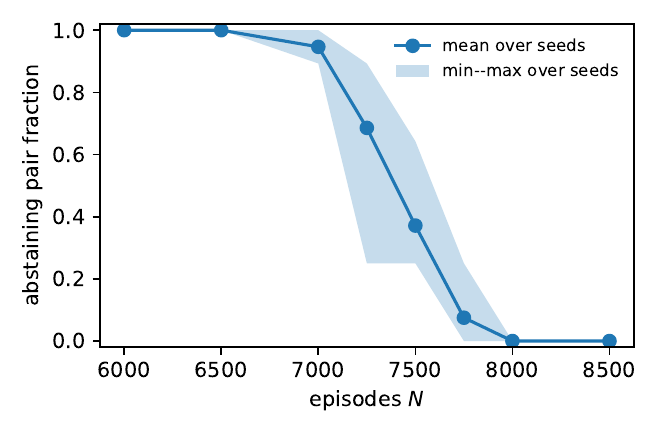
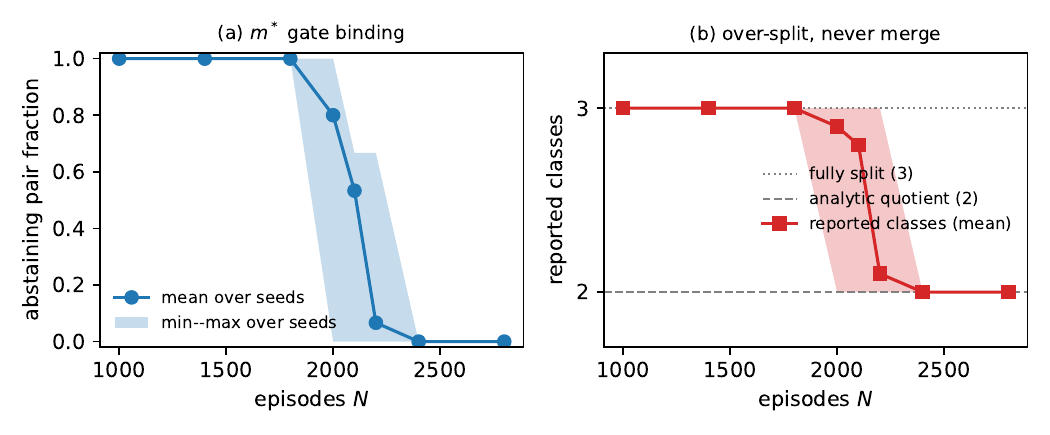
All code, results, and the paper source are in the public repository <https://github.com/npow/quotient-learning-papers>, directory `oql/`; every path below is relative to that directory, and the version cited here is the release tagged `v1`, which points to commit `83f9f42d8533c62fd05fcef2192559e0f80be3d9` of the public repository (tags can be retargeted, so the hash is the immutable reference; the `commit` field inside each JSON sidecar records the hash of the development repository at generation time and need not resolve in the public one). The exact commands, CSV rows, JSON sidecars, seeds, and package versions are under `experiments/main_table/results_independent_smoke`, `experiments/main_table/results_abstention_sweep`, `experiments/main_table/results_headtohead`, and one `experiments/main_table/results_*` directory per additional check above (`results_sweep_depth2`, `results_nested`, `results_multiendpoint`, `results_nondegenerate`, `results_posthoc`, `results_misspec`); the per-seed recovered partitions are in `experiments/main_table/results_partitions/partitions_per_seed.csv`. A SHA-256 manifest of these artifacts, the runners, the environments, the package, the paper source, and the lockfile is at `experiments/ARTIFACTS_MANIFEST.json`, and `python scripts/gen_manifest.py --check` verifies it. Tests check the TV calculation, sample bound, split disjointness, one-block invariant, Bonferroni level, action-aware alignment and stride, root exclusion, policy and environment generator independence, and sidecar validation. No external datasets, GPUs, or human data are used.
[under "What continuation law the routed class carries."]
**Proposition 10** (Routed laws). *Write $\lambda_g=\mathbb P(\text{routed to }g,\ Z\text{ reaches }r+k)$. Convention: $Q_g$ is defined only when $\lambda_g>0$, and terms with $\lambda_g=0$ are omitted from every sum and mixture below. Then, whenever $\lambda_h+\sum_{g\in G_h}\lambda_g>0$,
[under "What continuation law the routed class carries."]
and $Q_g=P_g$ for every $g\in\mathcal H$ with $\lambda_g>0$ that has no proper extension in $\mathcal H$. Consequently:*
[under "What continuation law the routed class carries."]
1. *If $\mathcal H$ is the full eligible universe (the event of Corollary 3), every history routes to a context of the maximal eligible length $\min(L,r+1)$. Hence a class all of whose members are non-maximal contexts has $\lambda_c=0$: it receives no routed histories and has no routed law (for example the singleton class $\{(0)\}$ in the nested $L=2$ example of Appendix G). For every class $c$ with positive routed mass $\lambda_c=\sum_{m\in c}\lambda_m>0$, the continuation law of the histories routed to $c$, given reaching $r+k$, is the mixture of $Q_m=P_m$ over the members $m$ with $\lambda_m>0$, and equals the common law $P_c$ of its members. The induced state map is total, but only classes with positive routed mass are ever the image of a history.*
[under "What continuation law the routed class carries."]
*Proof.* Every history in $E_h$ either routes to $h$ or matches some $g\in G_h$ and then routes to a longest match $g'$, which is longer than $g$ and so also has $h$ as a suffix, i.e. $g'\in G_h$ (histories routed to a context with $\lambda=0$ carry no mass and are omitted by the convention). Thus $E_h=R_h\sqcup\bigsqcup_{g\in G_h}R_g$, and the display is the law of total probability for $P_h=\mathbb P(C=\cdot\mid E_h,\text{reach})$. A context with no extension in $\mathcal H$ has $R_g=E_g$, so $Q_g=P_g$ when $\lambda_g>0$. In case 1 all routing is to maximal contexts, so $\lambda_m=0$ for non-maximal $m$; each member $m$ of $c$ with $\lambda_m>0$ satisfies $Q_m=P_m=P_c$, and if $\lambda_c>0$ the routed law is a mixture of equal laws, which is that law. For the last statement of case 2, if all $Q_g$ ($g\in G_h$) equal $P_h$, the display forces $Q_h=P_h$ when $\lambda_h>0$. ◻
[under "Algorithmic and reproducibility details"]
Pairwise work is $O(K^2(d+m_{\max}))$ with direct histograms, plus collection cost. Memory is $O(Kd+K^2)$ if all verdicts are retained. All runs are CPU-only in the audited environment: a few seconds per seed for the main-table checks (about three minutes for all $3\times20$ runs), under a minute for each 80-run abstention sweep, and a few minutes for the remaining Section 5 checks combined (the nested $L=2$ run, at $140{,}000$ episodes $\times$ 20 seeds, dominates); no GPU was used. Artifact locations: repository <https://github.com/npow/quotient-learning-papers>, directory `oql/`, release tag `v1` (commit `83f9f42d8533c62fd05fcef2192559e0f80be3d9`); result directories, the per-seed partition CSV and the SHA-256 manifest (`experiments/ARTIFACTS_MANIFEST.json`) are listed at the end of Section 5, and the environment specifications are in Appendix G. The project is released under the MIT license and the submission uses only synthetic environments implemented in the repository.Removed blocks
[under "Implementation checks"]
[under "Implementation checks"]
[under "Misspecification probe: the regime outside the gap model."] [block of 1481 characters not shown; it begins "All code, results, and the paper source are in the public repository <https://gi…"]
[under "What continuation law the routed class carries."]
**Proposition 10** (Routed laws). *Write $\lambda_g=\mathbb P(\text{routed to }g,\ Z\text{ reaches }r+k)$. If $\lambda_h>0$ then
[under "What continuation law the routed class carries."]
and $Q_g=P_g$ for every $g\in\mathcal H$ that has no proper extension in $\mathcal H$. Consequently:*
[under "What continuation law the routed class carries."]
1. *If $\mathcal H$ is the full eligible universe (the event of Corollary 3), every history routes to a context of the maximal eligible length $\min(L,r+1)$, and for each class $c$ the continuation law of the histories routed to $c$, given reaching $r+k$, is exactly the common law $P_c$ of its members. The routed class law is the quotient’s class law, and the induced state map is total.*
[under "What continuation law the routed class carries."] [block of 672 characters not shown; it begins "*Proof.* Every history in $E_h$ either routes to $h$ or matches some $g\in G_h$…"]
…and 1 more block not shown.